 Годовой курс видеолекций «Биохимия» профессора А.Д.Виноградова
 Видеолекция «Быстрые и медленные потенциалы действия в клетках сердца. Автоматия сердца» академика РАН Л.В.Розенштрауха
Просмотр
Заказ абонемента
 Видеолекция «Строение и функции центральных и нервно-мышечных синапсов» чл.корр. РАН Л.Г.Магазаника
 Видеолекция «Насосная функция сердца и её регуляция» профессора В.И.Капелько
 Видеолекция «Физиология системы крови» академика РАМН Ю.М. Захарова
 Видеолекция «Физиология почки» академика РАН Ю.В.Наточина
 Видеолекция «Общие вопросы физиологии эндокринной системы» профессора О.В.Смирновой
 Видеолекция «Рецепция и внутриклеточная сигнализация» академика РАН и РАМН В.А. Ткачука
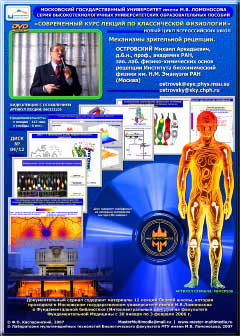 Механизмы зрительной рецепции (академик РАН М.А.Островский). DVD-видеолекция | Артикул 060131L05
 Видеолекция «Гравитационные механизмы в двигательной системе» чл.-корр. РАН И.Б.Козловской
 Видеолекция «Распознавание зрительных образов» академика РАН И.А. Шевелёва
 Видеолекция «Молекулярные механизмы пристрастий человеческого организма» академика РАМН И.П.Ашмарина
Увлекательная лекция о структурах и функциях наркотических веществ и физиологических механизмах возникновения пристрастий и зависимостей у человеческого организма
 20.05.2013
Курс видеолекций «Физиология растений» профессора В.В.Чуба
 Курс видеолекций «Цитология» профессора Ю.С.Ченцова
 Курс видеолекций «Физиология висцеральных систем» профессора В.Б.Кошелева
 Курс видеолекций «Антибиотики» заслуженного профессора МГУ Н.С.Егорова
 Курс видеолекций «Зоология беспозвоночных» профессора А.В.Чесунова
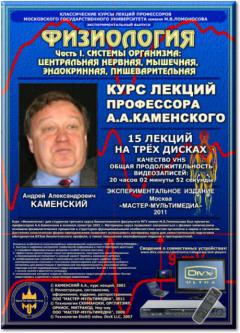 Курс видеолекций «Физиология возбудимых систем» профессора А.А.Каменского
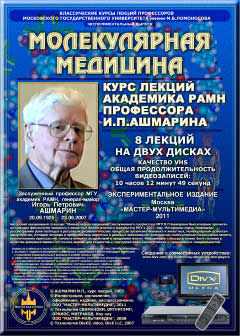 Курс видеолекций «Молекулярная медицина» академика РАМН И.П.Ашмарина
 Курс видеолекций «Зоология позвоночных» профессора Л.П.Корзуна
 Курс видеолекций «Высшие растения» профессора А.П.Меликяна
 29.09.2012
Glycolysis.m4v
Take a look at the ten enzymes that make possible the ten steps in the breakdown of sugar the process is called glycolysis.
 15.11.2012
Комплекс Гольджи, животная клетка
Аппарат Гольджи (комплекс Гольджи) — мембранная структура эукариотической клетки, органелла, в основном предназначенная для выведения веществ, синтезированных в эндоплазматическом ретикулуме. Аппарат Гольджи был назван так в честь итальянского учёного Камилло Гольджи, впервые обнаружившего его в 1898 году.
 13.11.2012
Митоз
http://www.medvasya.ru
 13.11.2012
Яйцеклетка и сперматозоиды
Видеосъёмка яйцеклетки, сперматозоидов и процесса оплоотворения под микроскопом.
 13.11.2012
Двойное оплодотворение цветковых растений.flv
Старый учебный фильм для ставки на http://fullbiology.ucoz.ru/
 13.11.2012
Мейоз.avi
Все видео из прогр."3D Человек" на http://fullbiology.ucoz.ru/
 13.11.2012
Мейоз
 08.10.2012
Cytoskeleton Microtubules | Cell Biology
Segment from the program Cells: The Structure of Life. To purchase this program please visit http://www.greatpacificmedia.com/
 08.10.2012
Cell Structure Overview | Cell Biology
Segment from the program Cells: The Structure of Life. To purchase this program visit http://www.greatpacificmedia.com/
 08.10.2012
mRNA Translation (Advanced)
The job of the mRNA is to carry the gene's message from the DNA out of the nucleus to a ribosome for production of the particular protein that this gene codes for.
Originally created for DNA Interactive ( http://www.dnai.org ).
TRANSCRIPT: The job of this mRNA is to carry the genes message from the DNA out of the nuceus to a ribosome for production of the particular protein that this gene codes for. There can be several million ribosomes in a typical eukaryotic cell these complex catalytic machines use the mrna copy of the genetic information to assemble amino acid building blokes into the three dimensional proteins that are essential for life. Lets see how it works. The ribosome is composed of one large and one small sub-unit that assemble around the messenger RNA, which then passes through the ribosome like a computer tape. The amino acid building blocks (that's the small glowing red molecules) are carried into the ribosome attached to specific transfer RNAs. That's the larger green molecules also referred to as tRNA. The small sub-unit of the ribosome positions the mRNA so that it can be read in groups of three letters known as a codon. Each codon on the mRNA matches a corresponding anti-codon on the base of a transfer RNA molecule.The larger sub-unit of the ribosome removes each amino acid and join it onto the growing protein chain. As the mRNA is ratcheted through the ribosome, the mRNA sequence is translated into an amino acid sequence. There are three locations inside the ribosome, designated the A-site, the P-site and the E-site. The addition of each amino acid is a three step cycle: First, the tRNA enters the ribosome at the A-site and is tested for a codon/anti-codon match with the mRNA. Next, provided there is a correct match, the tRNA is shifted to the P-site and the amino acid it carries is added to the end of the amino acid chain. The mRNA is also ratcheted on three nucleotides or one codon. Thirdly, the spent tRNA is moved to the E-site and then ejected from the ribosome to be recycled. As the protein synthesis proceeds, the finished chain emerges from the ribosome. It folds up into a precise shape, determined by the exact order of amino acids. Thus the Central Dogma explains how the four letter DNA code is - quite literally - turned into flesh and blood.
 08.10.2012
phagocytose 1
 08.10.2012
Powering the Cell: Mitochondria
Together Harvard University and XVIVO developed this 3D animation journey for Harvard's undergraduate Molecular and Cellular Biology students about the microscopic world of mitochondria. The animation highlights the creation of Adenosine Triphosphate (ATP) -- mobile molecules which store chemical energy derived from the breakdown of carbon-based food. ATP molecules act as a kind of currency, imparting chemical energy to power all the functional components of cellular activity. This piece is the second in a series of award winning animations XVIVO is creating for Harvard's educational website BioVisions at Harvard. The first program, Inner Life of the Cell, received international acclaim and can be seen both on our website and the BioVisions site.
http://www.xvivo.net
http://multimedia.mcb.harvard.edu/
 08.10.2012
Cells Cells - Parts of the Cell Rap
This rap was created for a 6th grade science classroom to teach about the different parts of a cell. With its catchy rhythm and rhymes, students of all learning styles and abilities will be able to learn about cells and their functions while having fun!
"Cells, Cells"
Original Rap by Ms. Quitmeyer
Today's the day were gonna learn about the cell
If I teach it okay, you'll know it very well
So listen up 6th graders-
-no room left for haters-
lets talk about the building blocks of life- cells that make us.
Chorus:
Cells, cells they're made of organelles
Try to pull a fast one, the cytoplasm gels
The nucleus takes over controllin' everything
The party don't stop 'till the membrane blocks the scene
Inside the vacuole we can float around for hours
Running round with chloroplasts, lovin' sunlight showers
Cells, cells, they're made of organelles
First things first, there's two different types-
animal and plant cells that make up all life.
The little things that make up microscopic cells,
The main structures- yeah, we call them organelles.
Now let's break it down and get some information-
How do cells work? It's a crazy combination!
-Chorus-
The cell membrane is the border patrol,
Who can cross over? The membrane lets 'em know
The gooey stuff inside, is called the cytoplasm
It holds the organelles- don't worry, plasm-has 'em!
In the middle of the cell you'll find the big brain,
The nucleus surrounded by nuclear membrane
Don't forget the vacuole filled up with water
It's a basic need for life when this rap keeps getting hotter!
-Chorus-
The mitchondria's something every cell needs,
Breaking down the food and releasin' energy.
There's a place inside the cell where chemicals are stored, the squiggly golgi bodies, releasin' even more.
Yo hangin' in the cell is endoplasmic reticulum, synthesizin' enzymes for respiration, and um...
If you still think that this rap is whack, remember ribosomes making proteins gettin' jacked!
-Chorus-
Lookin at the plant cell, weird and green
two more parts is all it takes you see?
Cell wall knows what's up when it comes to keepin' structure
Strong with cellulose, this cell can't get much tougher.
C-H- L-O- R-O -- Plast,
These little green machines are havin' a blast
Photosythenisizing- filled with chlorophyll
-they hit the cell club, runnin' up a high bill-
-Chorus-
 29.09.2012
Parts of a Plant Cell
 29.09.2012
Parts of an Animal Cell
 29.09.2012
Inside the Cell
The microscopic internal structures within a human cell are shown in this 3D, computer-generated animation. It is an educational general survey of the main organelles that contribute to the cell's function.
The depiction has realistic textures, forms and text, all in a camera "fly-by".
http://nature.ca
 29.09.2012
Cell Journey deep Inside
Journey inside the human cell
 29.09.2012
Journey Inside The Cell
http://www.discovery.org This animation shows how the digital information encoded in DNA directs protein synthesis inside the cell and provides a unique look at the evidence for intelligent design as describ